Tuesday, July 8, 2014

The Unseen Moment

Comforting a family
In the darkest hours
Celebrating a new life
On the brightest days
Caring for those who
No longer can for them selves
Compassion for those whom
Society deems unworthy
A routine that seems
Cold and methodical
Can be recited by a heart
That is so full
Of humanity and mercy
That it almost daily breaks
Spilling out behind closed doors
And into soft pillows
Only to be sutured by the understanding
Of an empathic companion
Who has also chosen to walk the path
Along a river forged by
The quiet tears of a Nurse.
    

by Laura Tarasoff
"I often see the tears of a nurse. Yesterday, stepping off the elevator I encountered such a moment. That inspired this."


My friend Laura wrote this beautiful poem that so captures


the experience of being a nurse. Thanks Laura for letting me


share this beautiful poem.

Saturday, May 10, 2014

of nursing and mothering


Add caption
This is Nurses Week. The one week a year when we stop and reflect upon the women and men who dedicate their lives to the care of the sick, the prevention of illness, and the development of health policy through nursing.


Nursing is one of the most misunderstood professions.
This is because much of what nurses do is invisible; it takes place within the mind of the nurse. Nurses observe patients, figure out what they need, whether with and without technical equipment. They see everything from noticing and smoothing wrinkles from under a patient, to locating a neighborhood where lead paint pollutes the dirt where children play, and advocating for clean-up. Nursing is seamless; there is no disconnect between the nurse's care, and the patient's experience.


Medicine and most of the healing arts are goal oriented, and are distinguished one from the other by their interventions: one does surgery, another dispenses medication, another does massage or reiki.

 
Nursing is not like these. Nursing is seamless vigilance; it is deciding what is necessary in the moment, being with the person, with the patient as they sail on through sickness on their journey  towards health ebbing and flowing. Health is about how well we live within our changing environment. The patient's limitation in caring for self is the determining factor in how the nurse will be with the patient. Health is not based upon circumstances; it is dependent upon how we living beings respond or adapt to circumstances. Nurses are our allies picking up the slack, sometimes for perfect strangers in the most intimate of ways.


It is appropriate that Nurses’ Week leads up to Mother’s Day. Florence Nightingale saw nursing as women’s work. “Every woman is a nurse.”, She said. Nursing is an extension of the work of nurturing life.


Taken as a whole, women are traditionally found in positions where their purpose is to support the birth, growth, and life of a person, a place, or a thing.
Whether we are serving as mothers, teachers, domestics, herbalists, village healers, or community health workers, veterinary technicians, nursing assistants, teachers aids, secretaries, or nurses, women’s work requires attention to the hundreds of changes that occur in daily life.


Woman’s work varies in the amount of attention and action required moment by moment by environmental flux, both internal and external to the entity for which we are caring.
Women’s work is so basic to life that we don’t even recognize that it is occurring,in our homes, our offices, our gardens, our hospitals, or classrooms, our forests. Women’s work is the web of nurturance that sustains.


Rianne Eisler described it as partnership and indeed it is. In my experience and my research it is not the man that is the partner of woman, it is the life for which she is caring. Together, the nurse and the life force with the support of men  partner to keep life going forward.


Men’s work is to, build the shelter, fix the plow, the car or the body; slaughter the cow for food or chop down the tree for wood, watch out for the hostile intruder who might disturb the flow of life.  


The work of men that is assistive to the continuous work of nurturing life not the other way around. Men’s work, is the model for the healing arts. It is goal oriented with a beginning a middle and an end.


Over millennia the work of men became dominant. Growing in status,  without awareness of their effect on life itsself, men produced and produced until like cancer the products of men’s work metatastized. Disconnected from life they have become the enemies of future life. Growth unbridled and for its own sake, whether in nature, in society, or in economics, leads to death.


So as we celebrate Nurses’ Week and Mother’s Day it is my fervent wish that day by day, we see more clearly, love more dearly, and protect more fully this miracle of life that is our Home. May women’s work be seen for its essential contribution to our continuance as a species, and may men’s work continue to develop only in those ways that sustain life for all beings here on Earth.


Wednesday, April 2, 2014

Why I Have Not Prepared for Disaster


When a mountain fell down, there was no warning; or was there? Geologists have done study after study and they knew the mountain would fail some day and come crashing down. Loggers had cut away trees from the side of the mountain decades ago and yes, even a short time ago just to the side of the place that cut away a logging company got permission to clear cut. Yet, the people felt they had no warning. The slide is 1 1/2 miles across at the top. But they called it Slide Hill! Here is an aerial photo showing the extent of the slide.
 Courtesy Gov. Jay Inslee via Flickr.

I understand. I have been pondering in my dreams what might happen here where I live. I try to think what might cause us to evacuate? What if we have no warning. What would I save? Is there anything aside from myself, my spouse, Mary, my dog Miles Jo Cocker, my two cats, Lili and Dash that I would try to bring with me?


What should I do to minimize the destruction? We have two 250 gallon propane tanks with open valves. Should I close them before leaving? Should I turn off the water; trip the circuit breakers?
Is there anything that I should do, that we should do? I have journals that I’ve been keeping since I was 16. They aren’t even in a box. I could get a metal box and store them, or I could transcribe them.
My resistance to preparing for a disaster is as big as the mountain that fell on the people who lived on Steelhead Dr.. Here is what it looked like before the slide. Now, the whole neighborhood is gone.


Steelhead Dr.  before the slide.
I resist even writing  here about the potential of a disaster. A great mountain of denial is protecting me from feeling the impermanence of this creation of ours -- this living being we call Gaia of which we are only a small part. We humans have built whole belief systems to protect us from our vulnerability.  We have become so comfortable in our denial that we are unwilling to face the fact even as we continue to over populate, over fish, over log. We would rather deny that we have created the conditions to which Gaia is responding with big weather than face our need to change the course of human civilization.  
If I can’t even muster up the courage to call my neighbors together to prepare for the earthquake we have been told by seismologists will come to us, how can I expect those who are profiting in the trillions from our civilizations depending upon big oil to give up their lion’s share of world’s resources to give up their search for big oil and natural gas?
Do I have the courage to care for my neighbors, my own legacy that is stored in my journals? I don’t have the answer. It is hard enough to have posed the question.What about you? Are you willing to look chaos in the face and stare down your fear? I'm curious about that; let me know what you think.

For those families in OSO you have brought out the best in all of us here in Washington. I am sorry for your loss yet grateful for the compassion you have shown and the community you are forging.

Sunday, February 16, 2014

Community Organizing the Woman's Way


“What we need beyond anything  else, is a frame of reference, a model of cherishing care for the earth and all human needs. … Have we, then, another model? I believe we have. It is women’s unremitting care for their families and homes. “  Margaret Mead 1970


Mead argued that the way women work, their centuries of experience in homemaking  is a viable framework needed to save the planet. We know that creating thriving communities is key to our survival as a human family during these turbulent times.
Creating thriving communities means kindly nurturing what is alive within the community. This might be a new model for community organizing: a woman's way of organizing through nurturing.

Nurturing requires watchfulness, gentleness, being awake and discerning what is needed. Nurturing is continuous, responding to subtle changes in the community so that what is needed to foster resilience is created, discovered or otherwise manifested.

Nurturing requires intimate knowledge of the community, a feeling for the organism. Nurturing is focused upon the present being of the community  always looking beyond the present that the future may materialize.

Nurturing includes play and rejoicing, music, art, laughter and beauty. These create resilient community and are nourished by a resilient community. 

 Community resilience is nourished by good ideas, humor, events, plans, good conversation, random acts of kindness, and a welcoming presence.

Resilience is seen in community gardens, thriving farms, ride share programs, credit union meetings, and community owned cooperatives, neighborhood tool sharing, and all efforts that support the health, the wholeness of community.

Nurturing requires a view of the organism as it is -- a living interdependent whole greater than the sum of assembled parts. 

Nurturing requires that we hold the sum of our knowledge with respect. Science, common wisdom, direct experience all support our ability to provide appropriate care to nurture the resilience of our community.
Nurturing requires foraging for those things which the community is lacking whether it is water or microloans or a source of affordable nutritious food or shelter.
Community organizing is just doing what is necessary.
You know how to do this if your mama taught you how to care for your family. The same principles apply. It is time to fearlessly take on the work of nurturing your community how ever you see it. If not you, who; if not now when?


Saturday, July 20, 2013

Compassion


Compassion


If I catch you
it is only for the moment.
This moment
only this one now,
where we are now,
and here.

If I catch you in the moment
I may find you by the blackened sea
 where there is so much room for light.
Sometimes I can shine a beam
into the blackness,
 in the moment
this moment,
only this one.

These moments are treasures,
 blue and green agates on the shores of my days.
Days when I can bring your smile up,
and out into the sun shine.
These treasures stack up
one on the next.
A sand castle on my beach.

Then,
Sometimes you catch me,
in momentum of your momentous moment.
You catch me.
Terrified, holding on for dear life
to the shore,
grasping at stones and shells,
the pieces of my life,
my memories of the past
what I was and what I was not.
Remenants of a life
far from here,
far from now.
Remenants from a life I know.

I listen
to the crashing waves
of your words
on the shores of this moment.
I listen.
As the tide rips me away.


It is here that I miss the mark.
The stones I send,
words really,
skip and bounce off the surface
of your sea change.

You call out,
I lock into your pain with my own.
 Grief sits like an ice castle.
In my solar plexus.
There is only heart freeze,
like brain freeze white and hot.
I write to melt the ice.

These close encounters
bring me to a place of deep knowing
 passing through immeasurable hurt and grief.
It hurts to hurt someone
you love this much.

So, at the edge of the tide I sit.
Quiet,
melting in the sun.
The pulsing blood in my temples
the heart of the universe
beating inside my body,
tells me
this is no ordinary journey.

The sea’s foamy fingers
play with
the stones and shells,
fingering melodies
ebbing flowing
over the souls of my feat.
Still
so still.
Breath flows
into my silent spaces.
Storms pass.
Calm returns me
to where there is so much room
for light in this moment,
here. now.


Monday, June 17, 2013

My Dad: A Father's Day Reverie


My Dad: A Father's Day Reverie

My Dad, Leo Michael Jackson, and Me.
  My dad,
 
He carried me on his shoulders.  While we sang God Bless America like Kate Smith.


He won thirteen turtles at the Cathedral Chapel Church Bazaar with a special spin he put on the ping pong ball that plopped them right into the fish bowl. These were magic turtles. They spent a year hiding in the bushes when I took them out for a walk and I found them the following Spring.
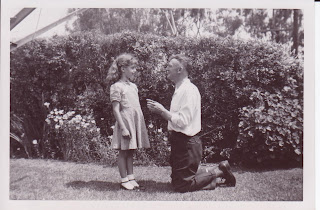
My dad loved flowers especially roses. He created a flower garden on the lot next to our house. We were poor then but that garden was my fairyland. Belle of Portugal roses grew on the vine that sheltered the rest of the yard from the prying eyes of cars on Rimpau Blvd. 


Once my dad brought home a surprise. A kite. We both loved flying kites. But this was no ordinary kite. This was a weather kite and it was big enough to carry me off. However in Los Angeles we never had a wind big enough to take it airborne. He was so hurt when I told him we couldn’t fly it. He was a very sensitive guy so I always had to watch myself.


My dad had a dark somber side. He loved the music of Wagner, Mahler, Verdi and Beethoven. He loved Verdi’s Aide, and Wagner’s Die Fleidermaus. His music would sap my energy. It felt as though my veins were filled with molasses instead of blood. I would beg him to turn it off; it filled me with sadness.


My dad was generous. When I told him that the high school needed a new organ, that cost $500. He wrote a check and handed it to me to give to Mother Eucharia.

My dad loved Mary, God’s mother. He always told my mother, “When you go to heaven you’ll be thanking St. Anthony, St. Joseph, St. Jude. while I’ll just go straight to Mary’s throne and say, ‘Thank you My Lady”.

My dad was a hard worker. He started with Hancock Dental Supplies as a stock boy around 1930. A salesman in the 40’s; and in 1950ish the company was renamed Hancock and Jackson and he became a full partner. 

My dad was honest. When Mister Hancock changed his will on his death bed leaving the business to his sister and the Mormon Church, my dad did not tear up the new will even though he was the only one who knew about it. He went to court and got the business fair and square.  
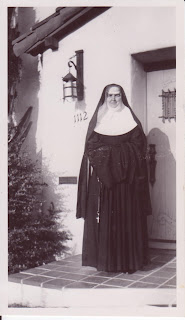
Sister Maria Ancilla, My mother's cousin.
When I went in the convent, My dad wrote me a love letter. He said that his heart was filled with love for his daughter. He always told me that when I came of age, he would go out and get drunk because is work was done. His world revolved around his only daughter and her mother. 

I entered the convent in 1959, and my dad wept as he said good bye at the convent gate. And every visiting Sunday he wept again. Yet, He was so proud the day I became a novice. That day he felt as though his work on earth was finished. So he wrote a letter to Sister Maria Ancilla, my mother’s cousin saying as much. 


It was a cold day in January I was in a music lesson with my dear mentor, Sister Mathias Martin. We were preparing for Sunday High Mass. I was in ecstasy when there was a knock on the music room door and a nun, white as a ghost summoned me to the Office of the Mistress of Novices. I thought I was in big trouble…. Again. I wasn’t in trouble, “Your father suddenly died of a heart attack.” Hit me in the face as though I had run into a brick wall. He hadn’t dropped dead he simply squatted down to admire the trim on the sliding door he had just installed on the back porch,  rolled over onto his side and died of a broken heart. Earth shattering was a term my father used a lot. And, his death shattered my world. 

I slammed the door shut for years. I didn’t sing, I could barely remember him. It was just too painful. Fueled by my grief, I set out to change the world. The civil rights movement, anti-war movement, I joined the Chicago Anti-Imperialist Collective, The Chicago Latin American Movement, The Medical Committee for Human Rights, the Anti-Nuclear Movement, The Women’s Movement. The Anti-War movement again, the Women’s movement again, and most recently the Equal Rights Movement.

My dad always wanted me to go to Stanford since Notre Dame didn’t take girls. So I got a BA, a BS, an MS, and a Phd instead and became a nurse and an anthropologist.

I taught, I nursed, I fought the Church and tried to figure out what I believed about God, Mary and the Saints.I returned to my Celtic/Catholic heritage honoring the Divine Feminine but not in the traditional church. 

Now I’m retired. I’m singing again, and I’ve begun to remember how much I loved my father and how much he loved me. 

My father was a caring man. I am so grateful for the life he shared with me, and for his contribution to my being who I am for indeed, I am my father’s daughter.